
Provably fair originals are the in-house games a crypto casino builds itself rather than licensing from a slot studio. Crash, Plinko, Mines, Dice, Limbo and the rest. They are fast, mechanically simple, and — unlike a slot — every round can be verified afterwards to prove the outcome was fixed before you placed your bet.
They also carry a house edge of roughly 1 percent, which is three to four times better than the average slot. This page explains how the verification works, what the maths behind each game looks like, and why the low edge does not make them safe.
What Provably Fair Actually Proves
Before a round starts, the site generates a server seed and publishes its SHA-256 hash. You supply or accept a client seed. Combining both with a nonce produces the outcome.
Because the hash was published first, the server cannot change the seed after seeing your bet without the hash failing to match. After the round the server seed is revealed and you can recompute the result yourself.

What this proves: the outcome was determined before you bet, and nobody altered it. What it does not prove: that the game is generous. The house edge is baked into the payout table and applies to a provably fair game exactly as it does to a slot. Full mechanics on the provably fair page.
Rotate your client seed occasionally. It costs nothing, it changes the outcome stream, and it removes any theoretical question about seed pre-selection.
The Games


| Game | Mechanic | Typical house edge |
|---|---|---|
| Crash / Limbo | Cash out before a rising multiplier stops | ~1% |
| Plinko | Ball falls through pegs into a payout slot | ~1% |
| Mines | Reveal safe tiles, avoid the bombs | ~1% |
| Dice | Predict over or under a chosen number | ~1% |
| Chicken Road | Advance lane by lane, cash out before a collision | ~1–2% |
| Keno | Pick numbers, match the draw | 3–8% |
| Blackjack | Standard rules against an automated dealer | ~0.5% with strategy |
| Wheel | Segmented wheel, selectable risk level | ~1–3% |
| Tower | Climb rows choosing safe tiles | ~1% |
| Rock Paper Scissors | Three-way match with a tie push | ~1–2% |
Crash and Limbo
A multiplier climbs from 1.00x and stops at a random point. Cash out before it stops and you keep the multiplier; fail and you lose the stake. Limbo is the same maths in one click: pick a target multiplier, and the round resolves instantly.
The distribution is memoryless. A run of ten low results tells you nothing about the eleventh — this is the single most misunderstood point about crash games, and it is the reason martingale strategies fail on them.
Plinko
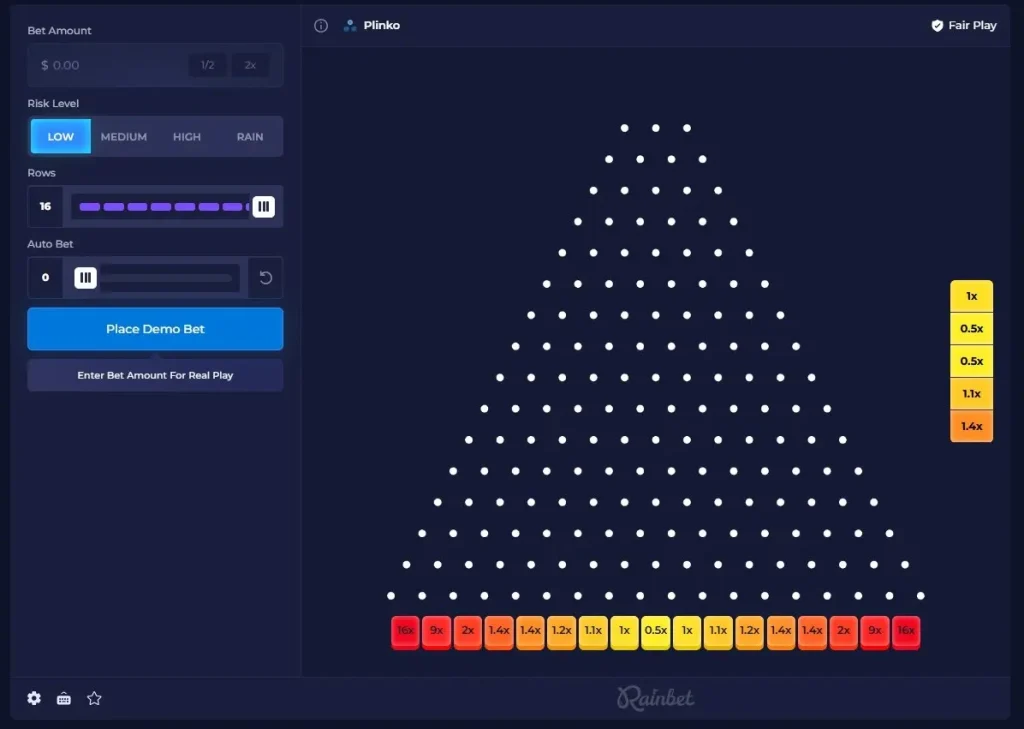
A ball drops through a triangular peg field into one of sixteen payout buckets. Outcomes follow a binomial distribution, so the centre slots are enormously more likely than the edges.
Risk level and row count reshape the payout table without changing the RTP: high risk moves value from the centre to the edges. The 1000x edge slot on a 16-row high-risk board comes up roughly once in 65,000 drops.
Mines
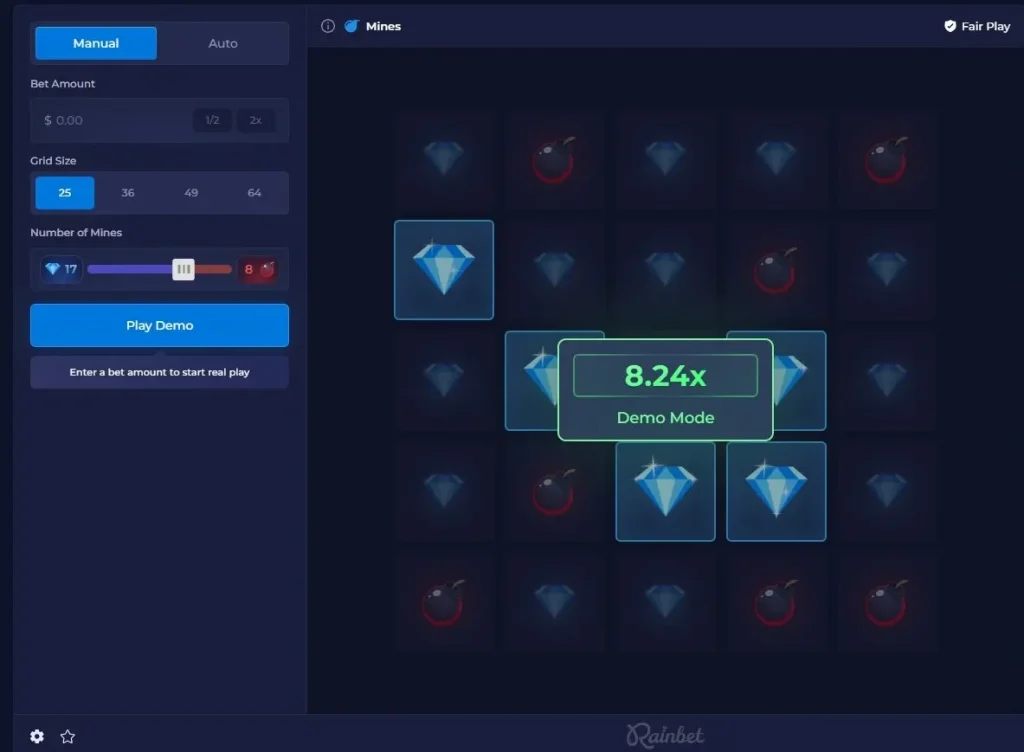
A five-by-five grid with a chosen number of hidden bombs. Each safe tile raises your multiplier; one bomb ends the round. With three bombs, the first reveal is safe 88 percent of the time and the multiplier barely moves. With twenty-four bombs, one tile pays 24x and succeeds 4 percent of the time. Same edge, opposite shape.
Dice
Choose a number between 0 and 99.99 and bet over or under it. The payout is derived directly from the probability you selected, less the house edge. It is the cleanest expression of the maths on the site, and the easiest to verify.
Why the Low Edge Is Not Safety
A 1 percent edge means a dollar wagered costs a cent in expectation. The trap is turnover. A crash round lasts a few seconds; a Mines round can be resolved in one click.
Play four hundred rounds an hour at 5 CAD and you have wagered 2,000 CAD — an expected loss of 20 CAD, but with a swing range of hundreds either side. The edge is small; the exposure is not.
Auto-bet and martingale scripts are available on most originals and are the fastest way to empty a balance. Doubling after each loss requires an exponentially growing bankroll and runs into the table maximum long before the run ends. The maths does not care that a loss streak feels overdue.
Originals Compared to Slots
- House edge: roughly 1 percent versus 3 to 5 percent on a typical slot.
- Round speed: one to five seconds versus three to six. Higher turnover per hour.
- Verification: per-round and self-checkable, versus certification of the RNG as a whole.
- Ceiling: 1000x on Plinko or unbounded on Limbo, versus 5,000x or more on a high-variance slot.
- Bonus weighting: originals are frequently excluded from wagering or weighted at 10 percent. Slots count fully.
Frequently Asked Questions
What are provably fair originals?
In-house casino games — Crash, Plinko, Mines, Dice, Limbo and similar — built by the operator rather than licensed from a slot studio. Each round uses a hashed server seed published before the bet, so the outcome can be independently verified afterwards. They typically run a house edge near 1 percent.
How do I verify a provably fair round?
Copy the server seed hash shown before the round, the client seed and the nonce. After the round the server seed is revealed; hash it and confirm it matches the hash published earlier, then recompute the outcome using the site's stated algorithm. Most sites provide a verification page, and third-party verifiers exist for the common games.
Which original has the best odds?
Blackjack played with correct basic strategy, at roughly 0.5 percent. Among the pure originals, Crash, Limbo, Plinko, Mines and Dice all sit near 1 percent regardless of the risk setting you choose. Keno is the outlier at 3 to 8 percent depending on the paytable.
Does changing the risk level change the RTP?
No. Risk and row settings redistribute the payout table without altering the expected return. High risk moves value from frequent small wins to rare large ones. The house edge stays where it is; only the variance changes.
Can I beat a provably fair game with a strategy?
No betting pattern changes a negative expectation. Each round is independent, so martingale and similar progressions only alter the shape of the loss — larger stakes chasing earlier losses, running into the table maximum. Provably fair proves honesty, not profitability.
Do originals count toward bonus wagering?
Often not, or only at a reduced weighting such as 10 percent. Their low house edge makes them poor value for the operator in a bonus context. Check the weighting table before claiming an offer if you intend to play them.