
The Plinko casino game drops a ball through a triangular field of pegs. Each peg deflects it left or right, and after sixteen rows it lands in one of seventeen payout slots — tiny multipliers in the middle, large ones at the edges. One click, two seconds, and a result you can verify afterwards.
It is one of the cleanest pieces of maths in any casino lobby, which also makes it one of the easiest to misunderstand. This page covers how the payout table is built, what the risk settings actually change, and what the realistic odds of hitting the edge slots are.
How Plinko Works
Choose a stake, a risk level and a row count, then drop. The ball hits the first peg and goes left or right with equal probability, repeats that for every row, and lands in the slot corresponding to how many rights it took.
Nothing steers it. The board is a physical metaphor for a binomial distribution, and the distribution is the entire game.
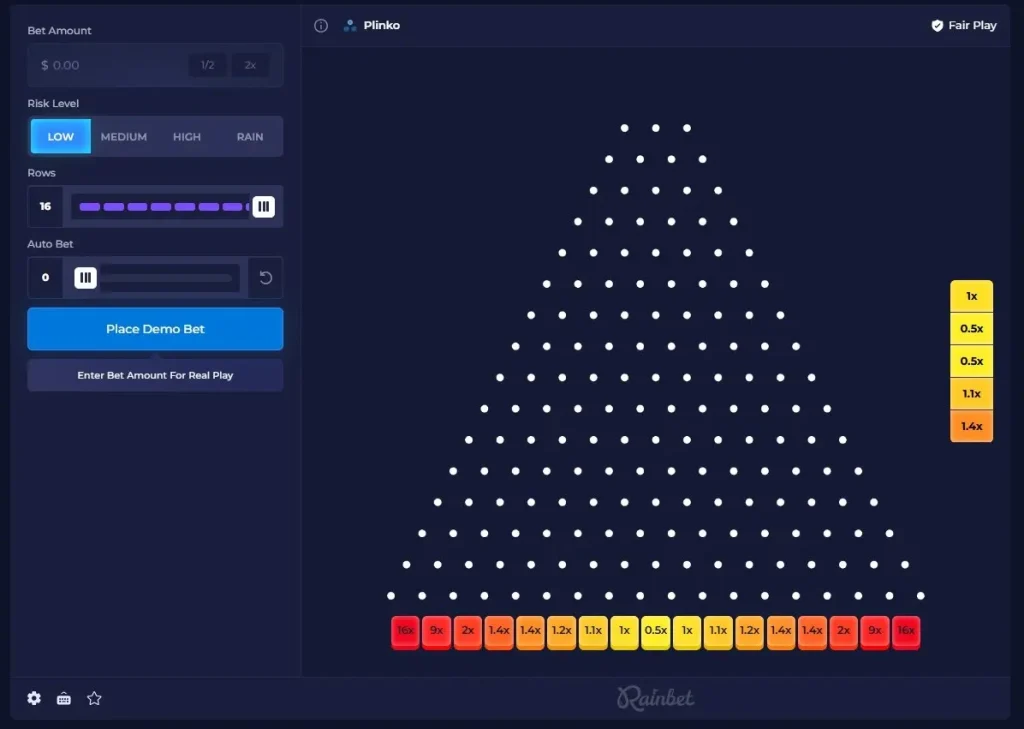
With sixteen rows there are 2^16 — 65,536 — possible paths. But those paths do not spread evenly across the slots. There is exactly one path that goes left sixteen times and lands in the far-left slot. There are 12,870 paths that split eight-and-eight and land dead centre.
| Slot position | Paths that reach it | Probability (16 rows) |
|---|---|---|
| Centre | 12,870 | 19.6% |
| One either side | 11,440 each | 17.5% each |
| Two either side | 8,008 each | 12.2% each |
| Four either side | 1,820 each | 2.8% each |
| Six either side | 120 each | 0.18% each |
| Outermost edge | 1 each | 0.0015% each |
That last row is the number worth internalising. The 1000x slot on a high-risk sixteen-row board comes up about once every 65,536 drops. At one drop every two seconds, that is roughly thirty-six hours of continuous play for one expected hit.
Risk Levels and Row Counts
Risk redistributes the payout table. It does not change the RTP, which stays at roughly 99 percent — a 1 percent house edge — across every setting.
Low risk flattens the table: the centre slots pay close to 1x rather than 0.5x, and the edges top out around 16x. High risk does the opposite, dropping the centre to 0.2x and pushing the edges to 1000x.
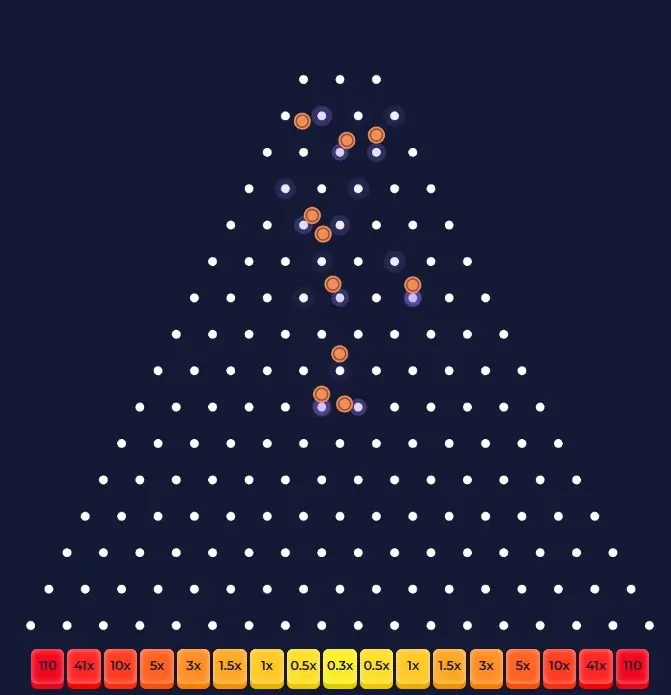
Row count works the same way. Eight rows produce nine slots and a maximum near 29x. Sixteen rows produce seventeen slots and a maximum of 1000x, with a correspondingly deeper centre trough.
| Setting | Centre payout | Edge payout | Effect |
|---|---|---|---|
| 8 rows, low | ~0.5x | ~5.6x | Shallow swings, frequent near-breakeven |
| 16 rows, low | ~0.5x | ~16x | Slowest bankroll decay |
| 16 rows, medium | ~0.3x | ~110x | Common middle ground |
| 16 rows, high | ~0.2x | ~1000x | Long losing runs, rare large hits |
The RTP is identical at every setting. Choosing high risk does not improve your expected return — it converts a series of small losses into a longer series of larger losses punctuated by an occasional large win. Pick the shape you want, not the one you think pays more.
Verifying a Plinko Round
Each drop is generated from a hashed server seed, your client seed and a nonce. The site publishes the hash before the round; afterwards it reveals the seed so you can confirm the hash matches and recompute the path.
- Note the server seed hash shown before you drop.
- Set or accept a client seed.
- Drop the ball and record the nonce.
- Rotate the seed pair — this reveals the old server seed.
- Hash the revealed seed and confirm it matches what was published, then recompute the path.
The full mechanism is on the provably fair page. It proves the outcome was fixed before your bet; it does not change the 1 percent edge.
Strategy, Honestly
There is no betting pattern that beats a negative expectation. What you can control is variance and turnover.
- Lower the risk level if you want a session to last. Low risk on sixteen rows has the shallowest drawdown curve available.
- Avoid auto-drop at speed. Plinko's danger is not the edge — it is that four hundred drops an hour at 5 CAD is 2,000 CAD of turnover and 20 CAD of expected loss, with a swing of hundreds.
- Ignore streaks. Every drop is independent. Ten centre results do not make an edge result due.
- Do not martingale. Doubling after each loss on a game where the centre slot pays 0.2x compounds faster than almost anywhere else on the site.
Plinko's one-click speed makes it the highest-turnover game in most lobbies. Set a loss limit and a session timer before you start, and treat the auto-bet feature as something to leave switched off.
Plinko Compared to Other Games
Against slots, Plinko wins on edge — roughly 1 percent versus 3 to 5 percent — and loses on ceiling. A high-variance slot can pay 10,000x; Plinko caps at 1000x.
Against Mines and Limbo, the edge is identical and the difference is purely in how the variance is shaped: Plinko gives you a fixed distribution, Mines lets you choose your exit point mid-round.

Frequently Asked Questions
How does the Plinko casino game work?
A ball drops through a triangular grid of pegs, deflecting left or right with equal probability at each one, and lands in a payout slot at the bottom. Centre slots pay small multipliers and are hit most often; edge slots pay large multipliers and are hit very rarely. You choose stake, risk level and row count before dropping.
What is the RTP of Plinko?
Around 99 percent, giving a house edge near 1 percent. That figure holds across every risk level and row count — the settings redistribute the payout table rather than changing the expected return.
What are the odds of hitting the 1000x slot?
On a sixteen-row high-risk board there are 65,536 possible paths and exactly one reaches each outermost slot, so the probability is about 0.0015 percent per drop — roughly one in 65,536. Hitting it is a genuinely rare event, not something to build a session around.
Does high risk mode pay better in Plinko?
No. High risk has the same RTP as low risk. It moves value from the frequently-hit centre slots to the rarely-hit edges, which means longer losing runs and occasional large wins. The expected return per dollar wagered is unchanged.
Is there a winning Plinko strategy?
No strategy overcomes the house edge, because every drop is independent and the expectation is negative at all settings. Risk level and row count let you choose how volatile the session feels, and bet sizing controls how long your bankroll lasts, but neither changes the maths.
Is Plinko provably fair?
On sites that implement it properly, yes. A hashed server seed is published before the drop, you provide a client seed, and after rotating seeds you can verify the hash and recompute the ball's path. That confirms the outcome was not altered after you bet.