
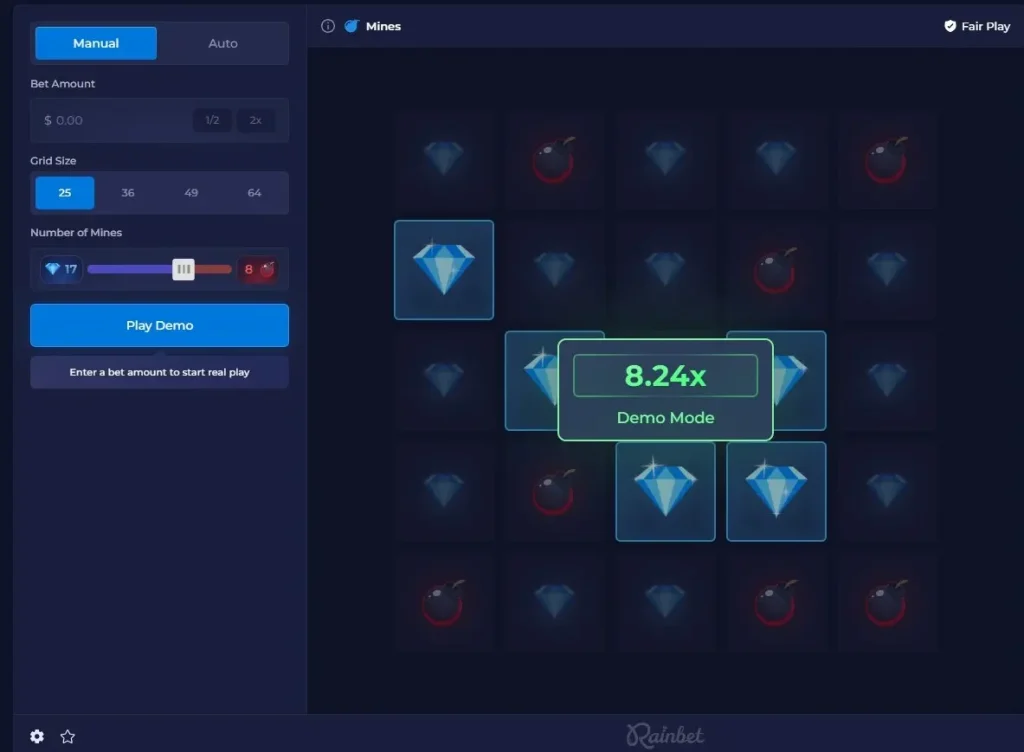
The Mines casino game is a five-by-five grid with a number of hidden bombs that you choose before the round. Every safe tile you reveal raises the multiplier. One bomb ends the round. You can stop and bank the multiplier at any point.
The interesting part is that you set your own odds. Choosing one bomb or twenty-four bombs changes the game completely while leaving the house edge exactly where it was.
How Mines Works
Pick a stake and a bomb count from 1 to 24. Twenty-five tiles are laid out, bombs are placed at positions fixed by the seed pair before you click anything, and you start revealing.
Each safe reveal increases the multiplier by an amount derived from how unlikely that reveal was. Cash out whenever you like; hit a bomb and the stake is gone.
The multiplier after k safe reveals with b bombs is the inverse of the cumulative probability of getting that far, less the house edge. With three bombs, the first tile is safe 22 in 25 times — 88 percent — so the multiplier barely moves. With twenty-four bombs, the first tile is safe 1 in 25 times, so it pays roughly 24x immediately.
| Bombs | 1st tile safe | 3 tiles safe | 5 tiles safe |
|---|---|---|---|
| 1 | 96.0% | 88.0% | 80.0% |
| 3 | 88.0% | 67.4% | 49.6% |
| 5 | 80.0% | 49.6% | 29.2% |
| 10 | 60.0% | 20.4% | 5.9% |
| 24 | 4.0% | — | — |
Choosing a Bomb Count
Low bomb counts give long, slow rounds with modest multipliers — you will reveal ten or twelve tiles before the payout becomes interesting. High counts give one-click rounds that either pay well or end immediately.
Both carry the same roughly 1 percent house edge. Neither is the better bet; they are different shapes of the same wager.

- 1–3 bombs — grind mode. Many reveals needed for a meaningful multiplier, shallow variance.
- 5–8 bombs — the common middle. A five-tile run pays a few times the stake.
- 10–15 bombs — short rounds, frequent losses, respectable payouts on a three-tile run.
- 20–24 bombs — effectively a single high-odds bet per round.
The bombs are placed before your first click, fixed by the server seed. Clicking corners, clicking the centre, or clicking in a pattern makes no difference — the layout does not respond to your choices.
Where the Edge Lives and How It Compounds
The edge is applied to the multiplier at each rung rather than taken once. That means a long run of reveals accumulates more house edge than a short one, in absolute terms — but proportionally it is identical. Cashing out early is a variance decision, not a value decision.
The real risk in Mines is the "one more tile" moment. After five safe reveals the multiplier on screen feels earned, but it is not banked until you press cash out, and the next click risks the entire accumulated amount on odds that have got worse with every tile you turned over.
Playing It Sensibly
- Decide the exit before the round. Three tiles at eight bombs, five tiles at five bombs — pick a rule and follow it.
- Use auto cash-out where the interface offers it. It removes the decision entirely.
- Do not read the grid. Tile position carries no information at all.
- Watch turnover, not stake. Rounds take seconds; a hundred rounds an hour at 5 CAD is 500 CAD wagered.
- Avoid progressions. Doubling after losses at ten bombs runs into the table maximum within a handful of rounds.
Verifying a Round
Bomb positions are derived from the hashed server seed, your client seed and the nonce. The hash is shown before the round; after rotating seeds you can confirm it and recompute where the bombs were. See provably fair.
Frequently Asked Questions
How does the Mines casino game work?
A five-by-five grid contains a number of bombs that you choose before the round starts. You reveal tiles one at a time, and each safe tile raises your multiplier. Revealing a bomb ends the round and loses the stake. You can cash out and bank the current multiplier at any point before the next reveal.
What is the RTP of Mines?
Around 99 percent, giving a house edge near 1 percent. This holds at every bomb count — choosing 24 bombs rather than 3 changes the shape of the payout dramatically but leaves the expected return unchanged.
How many mines should I choose?
Whichever variance you prefer. Three bombs means long rounds and slow multiplier growth; fifteen means most rounds end within a few clicks but a short run pays well. Neither returns more per dollar. Many players settle around five to eight as a balance.
Is there a pattern to where the mines are?
No. Bomb positions are fixed by the seed pair before your first click, distributed uniformly across the twenty-five tiles. Clicking corners, edges or the centre makes no difference, and the grid does not react to which tiles you choose.
What is the best Mines strategy?
Pre-committing to an exit point and using auto cash-out to enforce it. That controls variance and removes the psychological trap of pressing on after a good run. No strategy changes the expected return, which is negative at every setting.
Can I verify a Mines round was fair?
Yes, on sites implementing provably fair properly. The server seed hash is published before the round; after rotating seeds you can confirm the revealed seed matches that hash and recompute the bomb layout to verify it was set before you played.