
The Chicken Road game — also sold as Chicken Cross — is a cash-out game dressed as a road-crossing arcade title. A chicken advances one lane at a time. Each lane survived raises the multiplier. Each lane also carries a chance of ending the round. You decide when to stop.
It is the same mathematical shape as Crash, presented as a series of discrete choices rather than a rising curve, and that difference in presentation is why it plays very differently. This page covers the payout structure, what the difficulty settings change, and where the house edge actually lives.
How the Chicken Road Game Works
Place a stake and pick a difficulty. The chicken starts at the roadside with a multiplier of 1.00x. Tap to advance one lane; survive and the multiplier steps up. Hit traffic and the round ends with nothing.
Cash out at any point before advancing and you keep whatever the multiplier has reached. There is no partial loss — you either cash out or you lose the stake.
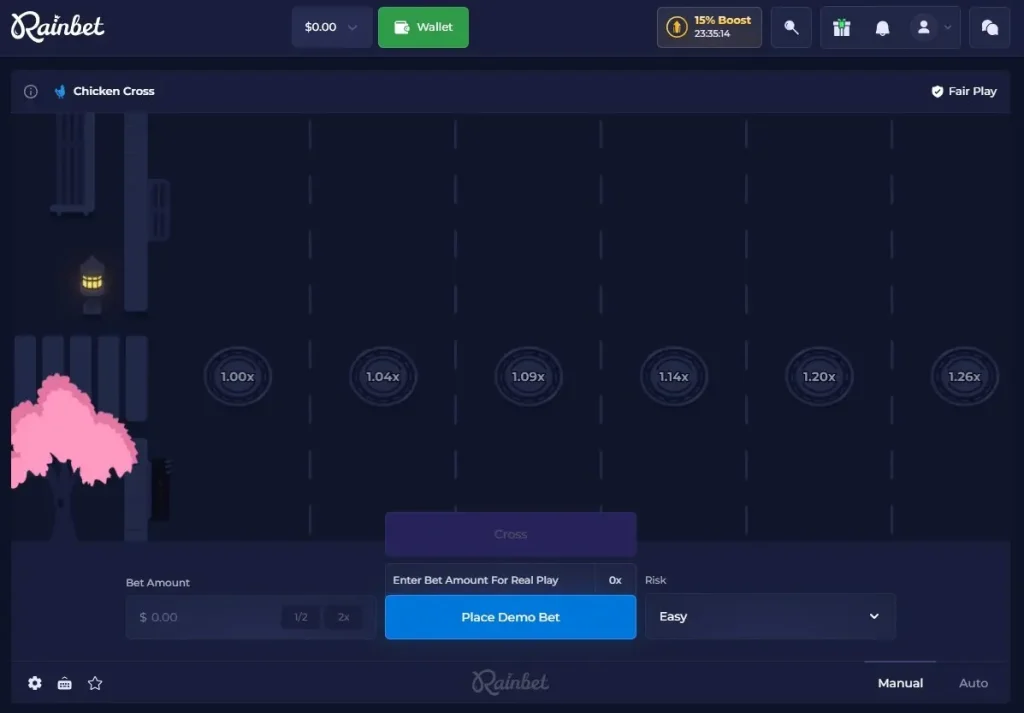
The multiplier ladder is derived from cumulative survival probability. If each lane is survived with probability p, the multiplier after n lanes is approximately (1 / p^n) × (1 − house edge). That is why the steps grow steeper the further you go: you are being paid for compounding risk.
| Lanes crossed | Approx. survival chance | Typical multiplier (medium) |
|---|---|---|
| 1 | ~92% | 1.07x |
| 3 | ~78% | 1.26x |
| 5 | ~66% | 1.49x |
| 10 | ~43% | 2.26x |
| 15 | ~29% | 3.42x |
| 20 | ~19% | 5.18x |
| 25 | ~12% | 7.85x |
The exact figures vary by operator and difficulty, but the shape is universal: surviving twenty lanes roughly one time in five pays roughly five times your stake. That is the engine of the game.
Difficulty Settings
Difficulty changes the per-lane survival probability, and the payout ladder rescales to match. The house edge stays put.
- Easy — high survival per lane, shallow multiplier growth, longer runs. Reaching 2x takes many lanes.
- Medium — the standard balance. 2x arrives around lane eight to ten.
- Hard — noticeably steeper steps, fewer lanes survived. 2x by lane four or five.
- Hardcore — very low survival per lane, extremely steep ladder. Most rounds end in the first few lanes; the rare long run pays hundreds.
Every difficulty carries the same expected return, typically a house edge between 1 and 2 percent. Hardcore is not more generous than Easy — it converts frequent small results into rare large ones. Choose the variance you want to sit through.
Where the Edge Lives
The house edge is embedded in the gap between the true odds and the paid odds. If surviving five lanes happens 66 percent of the time, fair odds would pay 1.515x. Paying 1.49x instead is where the roughly 1.5 percent edge comes from — applied at every rung, compounding quietly as you climb.
This matters for a common misconception. Cashing out early is not "safer" in expectation than cashing out late; the edge is proportional at every step. What early cash-out buys you is lower variance, not a better return.
The cash-out decision is where the game does its real damage. Having survived fifteen lanes, the multiplier on offer feels like something you already own — but it is not banked until you press the button, and the next lane is a coin-flip-shaped bet on the whole amount. Decide your exit lane before the round starts.
Playing It Sensibly
- Set a target lane and stick to it. Pre-commit to cashing out at, say, lane eight. The decision is far easier made before the round than during it.
- Use auto cash-out if available. It removes the moment of hesitation entirely, which is the point.
- Treat a survived run as a coincidence, not a pattern. Each lane is independent; three long runs do not make a fourth likely or unlikely.
- Watch the turnover. Rounds take seconds. Two hundred rounds an hour at 5 CAD is 1,000 CAD wagered.
- Leave martingale alone. Doubling after losses on a game where most rounds end early runs into the table maximum fast.
Verifying a Round
Chicken Road is implemented as a provably fair game on sites that support it. Each round's collision points are derived from the hashed server seed, your client seed and the nonce, all of which are published before you play.
After the round you can rotate seeds, reveal the server seed, confirm it hashes to the value you were shown, and recompute which lane the collision was set to. See provably fair for the full procedure.
How It Compares
| Game | Shape | House edge |
|---|---|---|
| Chicken Road | Discrete lanes, manual cash-out | ~1–2% |
| Crash / Limbo | Continuous multiplier, manual cash-out | ~1% |
| Mines | Grid reveals, manual cash-out | ~1% |
| Plinko | Fixed distribution, no decision | ~1% |
| Tower | Row-by-row climb, manual cash-out | ~1% |
Mines and Tower are the closest relatives — all three are "keep going or stop" games where the decision, not the mechanic, carries the tension. Plinko is the opposite: once dropped, there is nothing to decide.
Frequently Asked Questions
How does the Chicken Road game work?
You stake an amount and advance a chicken across a road one lane at a time. Each surviving lane increases your multiplier; hitting traffic ends the round and loses the stake. You can cash out at any point before advancing again, keeping whatever the multiplier has reached.
What is the RTP of Chicken Road?
Typically 98 to 99 percent, so a house edge of roughly 1 to 2 percent depending on the operator's implementation. The figure is the same across every difficulty setting — difficulty changes how volatile the game feels, not what it returns.
Which difficulty is best in Chicken Road?
None returns more than another. Easy gives frequent small multipliers and long rounds; Hardcore gives mostly short rounds and rare large payouts. Pick based on how much variance you want, and note that steeper ladders make the cash-out decision harder rather than more profitable.
Is there a strategy for Chicken Road?
The only meaningful discipline is deciding your cash-out lane before the round starts and using auto cash-out to enforce it. No progression system overcomes a negative expectation, and doubling after losses hits the table maximum quickly because most rounds end early.
Is Chicken Road the same as Chicken Cross?
They are the same format under different names. Several studios have released versions since the mechanic became popular, with small differences in lane count, difficulty labels and maximum multiplier, but the underlying maths is identical.
Is Chicken Road provably fair?
On sites that implement it as an original, yes. The collision lane is derived from a server seed hashed and published before the round, combined with your client seed and a nonce, so you can verify afterwards that the outcome was fixed before you bet.