
The Tower game is a vertical climb. Each row offers a handful of tiles, one or more of which ends the round. Pick a safe tile and you advance a row and the multiplier rises. Cash out at any point, or keep climbing.
It is the same "keep going or stop" shape as Mines and Chicken Road, arranged as a ladder. The difficulty setting decides how many tiles per row are safe, and therefore how steep the ladder is.
How Tower Works
Choose a stake and a difficulty. The tower is typically eight or nine rows tall. Each row contains a fixed number of tiles, of which a known number are safe.
Click a tile in the bottom row. Safe, and the row above unlocks with a higher multiplier attached. Unsafe, and the round ends. Cash out between rows to bank the current multiplier.
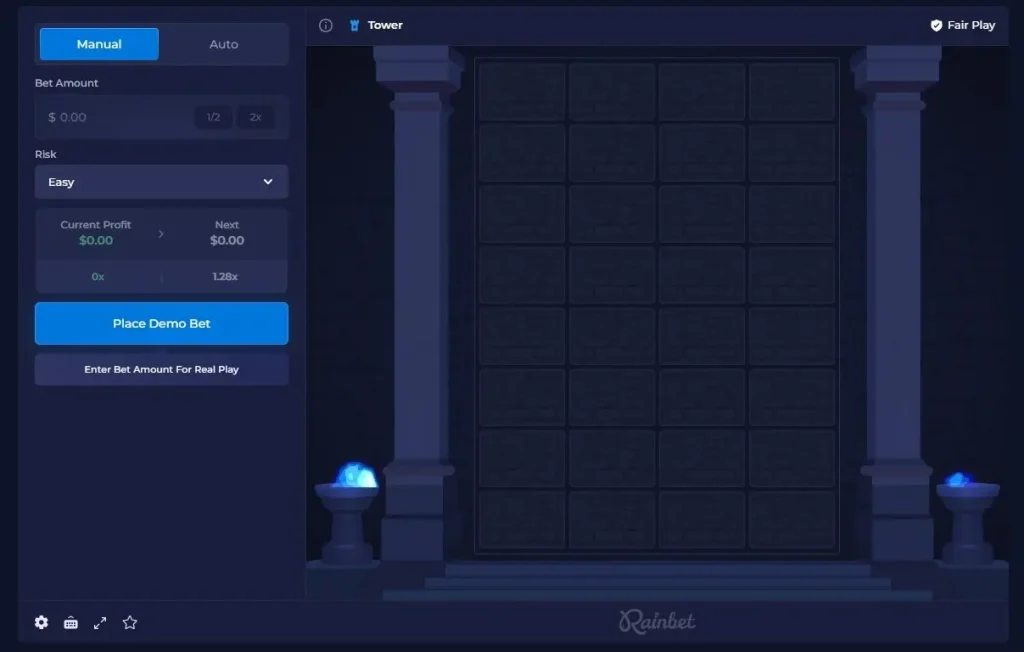
Because the number of safe tiles per row is published, the odds are transparent. On an "easy" setting with three tiles per row and two safe, each row is survived two times in three. On "hard" with four tiles and one safe, each row is survived one time in four.
| Difficulty | Tiles per row | Safe per row | Row survival | Multiplier growth |
|---|---|---|---|---|
| Easy | 4 | 3 | 75% | ~1.31x per row |
| Medium | 3 | 2 | 66.7% | ~1.48x per row |
| Hard | 2 | 1 | 50% | ~1.98x per row |
| Expert | 3 | 1 | 33.3% | ~2.97x per row |
| Master | 4 | 1 | 25% | ~3.96x per row |
Where the Edge Sits
The multiplier per row is the inverse of the survival probability, less roughly 1 percent. On medium, fair odds for a 66.7 percent survival would be 1.50x; the game pays about 1.48x. Compounded over eight rows that is still a 1 percent edge overall, not 8 percent — the edge is proportional, not additive per rung.
Every difficulty carries the same expected return. Master mode is not more generous than Easy; it converts a long, shallow climb into a short, steep one. Choose the variance, not the "value".
Playing It
- Pick a target row before you start. Row four on medium, row three on hard — a rule you can follow mechanically.
- Use auto cash-out if the interface supports it.
- Ignore tile position. Safe tiles are placed by the seed before your first click; left, right and middle are identical.
- Respect the turnover. Rounds are quick, and quick rounds accumulate wagered volume faster than the balance suggests.
The higher you climb, the more the accumulated multiplier feels like yours — and the more each additional row risks. On Master mode, row six risks everything banked on a 25 percent chance. Decide the exit before the emotion arrives.
Verifying a Round
Safe tile positions for every row are fixed by the hashed server seed, your client seed and the nonce, all committed before your first click. Rotate seeds afterwards to reveal and verify. Full procedure on the provably fair page.
Frequently Asked Questions
How does the Tower game work?
You climb a tower row by row, choosing one tile per row. Safe tiles advance you and raise the multiplier; losing tiles end the round. You can cash out between any two rows to bank the multiplier you have reached.
What is the RTP of Tower?
Around 99 percent, giving a house edge near 1 percent. That figure is the same across every difficulty setting, because the multiplier ladder rescales to match the survival probability at each level.
Which Tower difficulty pays best?
None pays better in expectation. Easy gives a high chance per row and slow multiplier growth; Master gives a 25 percent chance per row and steep growth. The expected return per dollar is identical — only the shape of the outcome changes.
Is there a pattern to the safe tiles?
No. Positions are determined by the seed pair before your first click and are distributed uniformly within each row. Choosing the left, middle or right tile makes no difference to the outcome.
What is the best Tower strategy?
Deciding your exit row in advance and using auto cash-out to enforce it. That caps variance and removes the in-round decision, which is where most losses in cash-out games actually originate. No strategy changes the negative expectation.
Is Tower provably fair?
Yes, where the operator implements it as an original. The layout of safe and losing tiles is derived from a server seed hashed and published before the round, so you can verify afterwards that it was fixed before you played.