
Crypto dice is the most stripped-down wager in any casino. A number between 0 and 99.99 is generated. You pick a threshold and bet whether the result will be over or under it. The payout is computed directly from the probability you chose.
There is no theme, no bonus round and no decision once the bet is placed. That makes it the clearest place to see how a house edge actually works, which is why it has been the default crypto casino game since the earliest bitcoin sites.
How Crypto Dice Works
Move a slider to set your threshold, choose over or under, and place the bet. The interface shows your win chance and the payout multiplier updating live as you drag.
Roll under 50 and you win 49.5 percent of the time for roughly 2x. Roll under 95 and you win 94.05 percent of the time for roughly 1.05x. Roll under 2 and you win 1.98 percent of the time for roughly 50x.
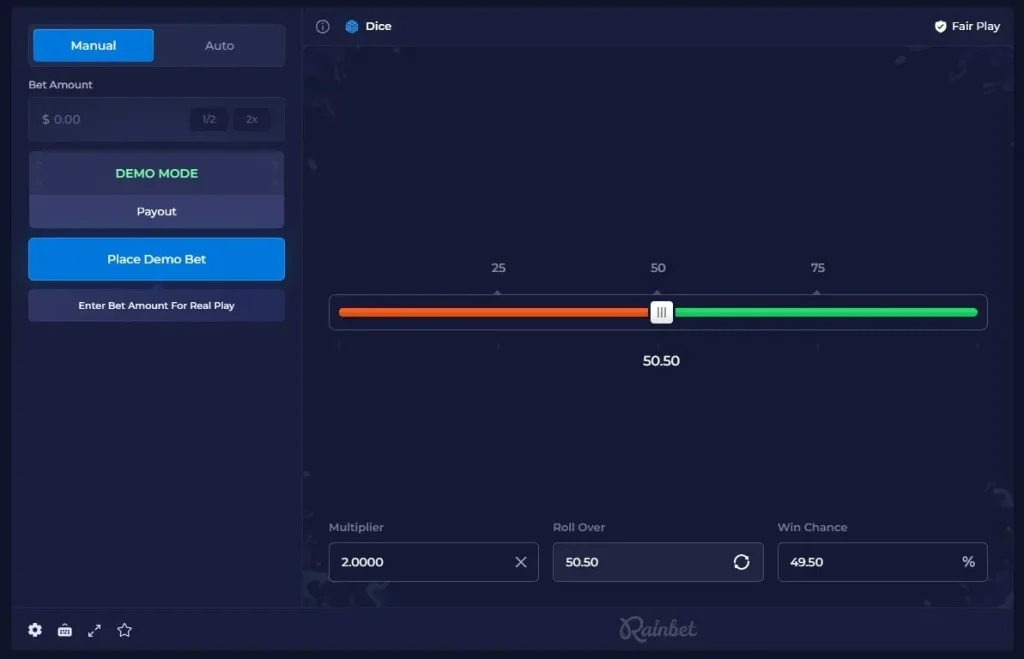
The formula is simple: payout ≈ 99 ÷ win chance. The 99 rather than 100 is the 1 percent house edge, and it is applied identically at every threshold.
| Win chance | Payout | Roll under | |
|---|---|---|---|
| 98.00% | 1.01x | 98.00 | |
| 94.05% | 1.05x | 94.05 | |
| 75.00% | 1.32x | 75.00 | |
| 49.50% | 2.00x | 49.50 | |
| 24.75% | 4.00x | 24.75 | |
| 9.90% | 10.00x | 9.90 | |
| 1.98% | 50.00x | 1.98 | |
| 0.99% | 100.00x | 0.99 |
Why the Edge Is the Same Everywhere
Fair odds on a 49.5 percent chance would pay 2.0202x. The game pays 2.00x. That 1 percent shortfall is the house edge, and it scales proportionally at every threshold.
Set the slider to a 1 percent win chance and fair odds would be 100x; you are paid 99x. Set it to 95 percent and fair odds would be 1.0526x; you are paid 1.042x. Same proportion, every time.
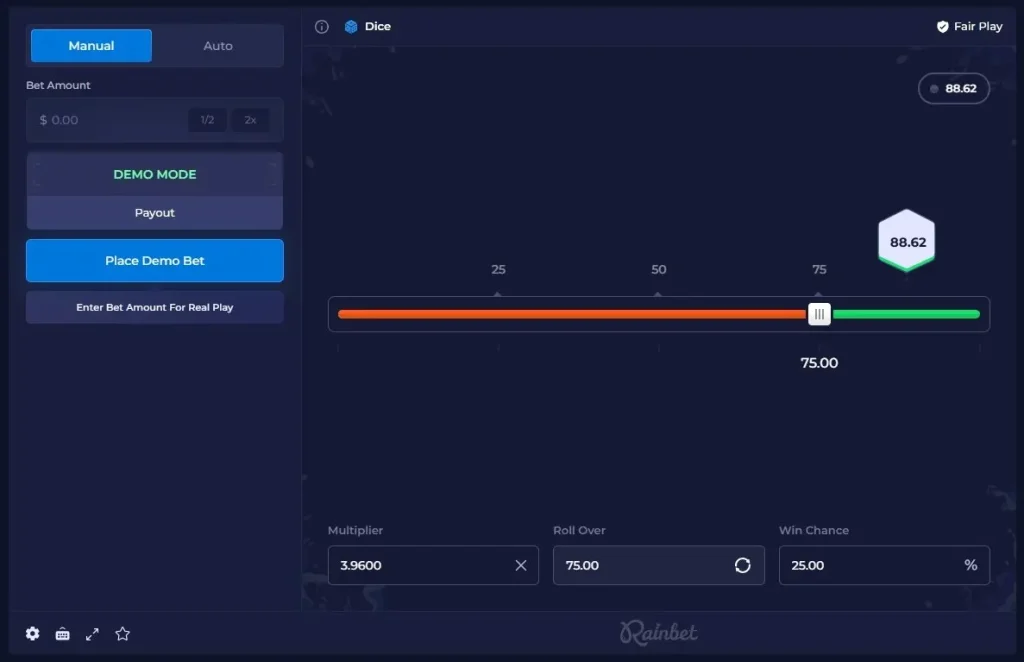
Because the edge is proportional, there is no "best" threshold. A 98 percent win chance and a 1 percent win chance return the same amount per dollar over the long run. They differ only in how violently the balance moves along the way.
Strategy and the Martingale Problem
Dice attracts betting systems more than any other game, and none of them work. The most common is martingale: bet at roughly 50 percent win chance, double after every loss, reset after a win.
It appears to work because it wins small amounts frequently. What it does is trade many small wins for one catastrophic loss. A ten-loss streak at 49.5 percent happens about once every thousand sequences, and recovering from it requires 1,024 times the base stake — which will exceed either your balance or the table maximum first.
Auto-bet scripts with a martingale progression are the fastest documented way to lose a crypto casino balance. The game runs hundreds of rounds a minute, so a sequence that would take hours by hand completes in seconds.
What actually helps: pick a threshold whose variance you can sit through, keep the stake to a small fraction of the balance, and set a stop-loss that the auto-bet feature will respect.
Verifying a Roll
Dice is the easiest provably fair game to check because the output is a single number. The roll is derived from the server seed, your client seed and the nonce:
- Record the server seed hash shown before betting.
- Set a client seed of your own.
- Place bets, noting the nonce for each.
- Rotate seeds to reveal the server seed.
- Hash it, confirm it matches, then recompute any roll from the three inputs.
Full details on the provably fair page.
How Dice Compares
Limbo is the same bet with a different interface — you choose a multiplier instead of a probability, and the arithmetic converts between them. Plinko fixes the distribution for you rather than letting you set it. Mines adds a cash-out decision mid-round. All four sit at roughly a 1 percent edge.
Frequently Asked Questions
How does a crypto dice game work?
A number between 0 and 99.99 is generated for each bet. You set a threshold and choose whether the result will roll over or under it. The payout multiplier is calculated from the probability of your selection, so a narrow range pays more and a wide range pays less.
What is the house edge on crypto dice?
Typically 1 percent, which is why payouts are calculated as 99 divided by your win chance rather than 100. The edge is proportional, so it is identical whether you bet at a 98 percent win chance or a 1 percent one.
Does the martingale system work on dice?
No. Doubling after losses produces frequent small wins and occasional total losses, and the expected value is unchanged. A ten-loss streak at even money requires 1,024 units to recover and occurs roughly once in a thousand sequences — you run out of balance or hit the table cap first.
What win chance should I choose?
Whichever variance suits your bankroll. High win chances produce steady small returns with shallow swings; low win chances produce long losing runs and occasional large payouts. Neither is more profitable, because the house edge is the same proportion at every setting.
Is crypto dice provably fair?
It is the canonical provably fair game. Each roll comes from a hashed server seed published before the bet, your own client seed, and an incrementing nonce. After rotating seeds you can verify the hash and recompute every roll you made.
Can dice results be manipulated by the casino?
Not on a correctly implemented provably fair site. The server commits to its seed by publishing the hash before any bet, so changing the seed afterwards would break the hash. That is exactly what the verification step checks.