
Casino rakeback returns a percentage of everything you wager, win or lose. Cashback returns a percentage of what you lose. Both are loyalty mechanics, both reduce the effective house edge, and both are worth considerably more over time than any welcome bonus — because they are certain rather than probabilistic.
This page explains how the two differ, how VIP tiers actually work, and how to calculate what a programme is genuinely returning to you.
Rakeback vs Cashback
They sound similar and behave very differently. Rakeback is proportional to turnover; cashback is proportional to losses. Which is better depends entirely on how much you wager relative to how much you lose.
A high-volume player on low-edge games accumulates far more from rakeback. An occasional player on high-variance slots gets more from cashback.

| Comparison | Rakeback vs cashback | |
|---|---|---|
| Based on | Every wager placed | Net losses over a period |
| Typical rate | 0.1% – 1% of turnover | 5% – 20% of losses |
| Paid when | Continuously, or daily | Weekly or monthly |
| Paid if you win | Yes | No |
| Best for | High turnover, low-edge games | Lower volume, higher variance |
| Predictability | Very high | Moderate |
Worked example. Wager 50,000 over a month on games with a 2 percent edge, expected loss 1,000.
- At 0.5 percent rakeback: 250 returned, regardless of outcome.
- At 10 percent cashback: 100 returned, but only if you actually finished down.
At that volume rakeback wins comfortably. At 5,000 of turnover with a 500 loss on high-variance slots, cashback returns 50 and rakeback returns 25. The crossover depends on your volume and the edge you play at.
VIP Tiers
Tiers are driven by cumulative wagering. Each level raises the rakeback percentage, the cashback percentage, or both, and adds periodic bonuses — daily, weekly and monthly drops that scale with the tier.
The numbers grow quickly on paper. What matters is what the tier is worth against what it costs to reach.
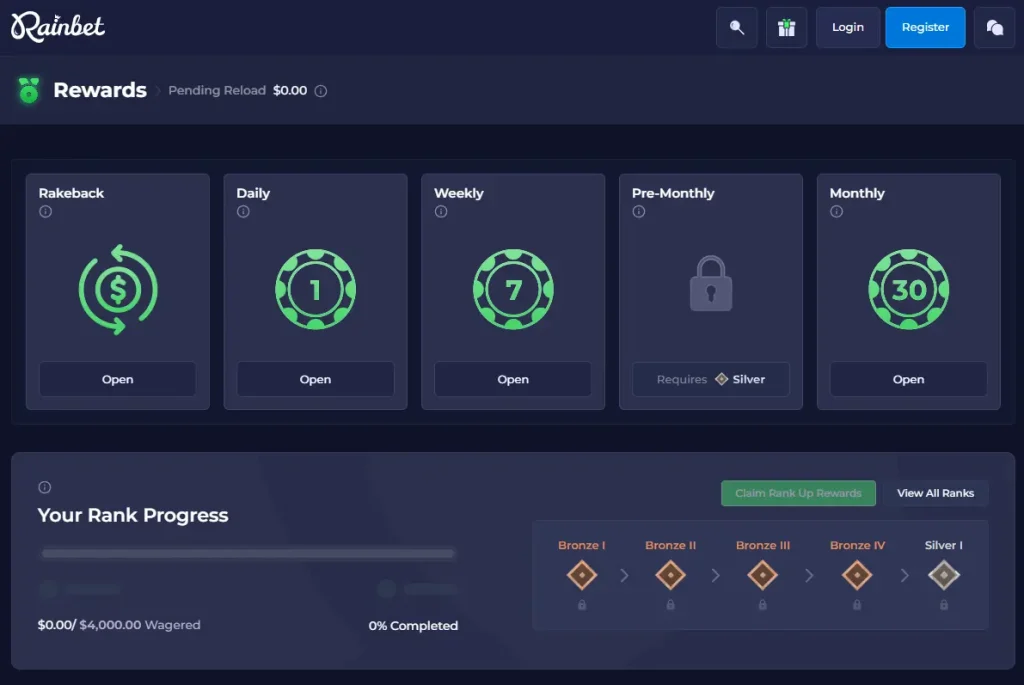
A tier requiring 500,000 of cumulative wagering to unlock a 0.8 percent rakeback rate sounds generous. That 500,000 of turnover, on games with a 2 percent edge, has an expected cost of 10,000. The rakeback on it is 4,000. Reaching the tier was not free.
VIP progress bars are designed to be motivating, and that is exactly the problem. A tier is worth reaching only if you were going to wager that amount anyway. Wagering more to reach a tier costs several times what the tier returns.
Reading a Programme Honestly
- Find the rakeback percentage at your realistic tier, not the top one.
- Check whether payouts are cash or bonus funds. Bonus funds with 30x wagering are worth a fraction of face value.
- Check the claim window. Unclaimed daily and weekly drops usually expire.
- Check game weighting. Originals and live dealer often accrue at reduced rates.
- Convert to a percentage of the house edge. A 0.5 percent rakeback on a 2 percent edge game returns a quarter of the edge — a genuinely meaningful reduction.
The most useful way to think about rakeback is as an RTP adjustment. On a 96 percent slot, 0.5 percent rakeback on turnover makes the effective RTP 96.5 percent. That is a larger improvement than switching between most slot titles.
Other Reward Mechanics
- Daily, weekly and monthly bonuses — small credited amounts, usually tier-scaled, frequently with wagering attached. Claim them; do not play extra for them.
- Level-up bonuses — one-off payments when crossing a tier boundary.
- Challenges — fixed objectives with fixed rewards.
- Weekly raffles — tickets earned from turnover, random draw.
- Reload offers — covered on the promotions page.
Of these, only rakeback and cashback are reliable. Everything else is variance dressed as reward.
Frequently Asked Questions
What is casino rakeback?
A percentage of every wager returned to you regardless of whether the bet won or lost. Rates are typically 0.1 to 1 percent of turnover and scale with VIP tier. Because it applies to all wagering rather than only to losses, it functions as a direct reduction in the effective house edge.
How is rakeback different from cashback?
Rakeback is proportional to how much you wager and pays whether you win or lose. Cashback is proportional to net losses over a period and pays nothing in a winning period. High-volume players generally get more from rakeback; occasional players get more from cashback.
Are VIP programmes worth chasing?
Only if the wagering that unlocks them is wagering you would have done anyway. A tier requiring 500,000 of turnover costs roughly 10,000 in expected losses at a 2 percent edge, and returns considerably less than that in rakeback. Progress bars are motivational design, not value.
Is rakeback paid as cash or bonus funds?
It varies by operator and it is the term that matters most. Cash rakeback is withdrawable immediately and worth its face value. Rakeback credited as a bonus with a wagering requirement attached is worth a fraction of the stated amount.
How much does rakeback actually improve my odds?
Treat it as an RTP adjustment. On a game with 96 percent RTP, 0.5 percent rakeback on turnover raises the effective return to about 96.5 percent. That is a bigger improvement than most players achieve by switching games.
Do all games earn the same rakeback?
No. Slots usually accrue at the full rate; live dealer, table games and in-house originals frequently accrue at a reduced rate or not at all, because their house edge is too low to fund the reward. The weighting table is in the programme terms.