
Rock paper scissors online as a casino game strips the playground original down to a single wager: pick one of three, the house picks one at random, and you win, lose or push. There is no reading your opponent, because there is no opponent — just a seeded random draw.
That makes it the simplest three-way bet in any originals lobby, and a useful illustration of how a house edge can be hidden in a game that looks perfectly even.
How It Works
Choose rock, paper or scissors and place a stake. The house selection is generated from the current seed pair and nonce. Rock beats scissors, scissors beats paper, paper beats rock, and matching selections push.
Each of the three outcomes — win, lose, push — occurs one third of the time. The game returns your stake on a push, so effectively you have a 50 percent chance of winning among decided rounds.
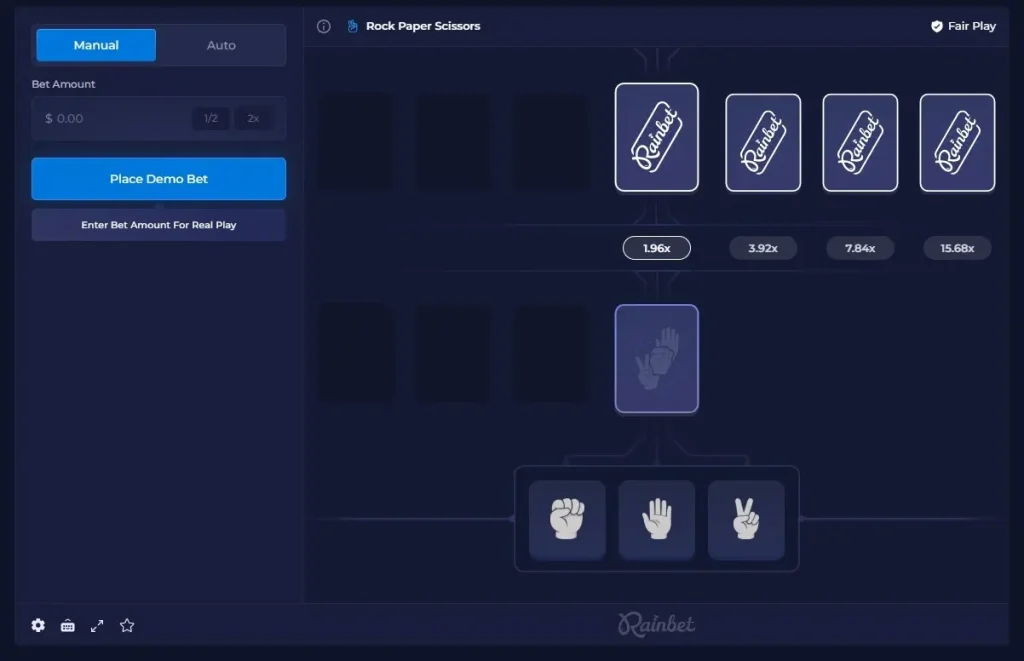
The payout on a win is typically around 1.96x rather than 2.00x. That shortfall, applied only to the two-thirds of rounds that resolve, is the house edge — usually between 1 and 2 percent.
| Outcome | Probability | Result |
|---|---|---|
| Win | 33.3% | Paid ~1.96x stake |
| Push | 33.3% | Stake returned |
| Lose | 33.3% | Stake lost |
Because a push returns the stake, the game feels close to even money. It is not: the winning payout is slightly under 2x, and that gap is what the house keeps. Over a long session it behaves exactly like any other 1 to 2 percent edge.
Strategy
There is none, and that is the point. The house selection is generated randomly and independently for every round, so there is no tendency to exploit, no pattern to read and no advantage to alternating your picks.
- Your selection does not matter. Rock, paper and scissors all have identical expectation.
- Pushes are not wins. A run of pushes neither helps nor harms; they simply do not resolve.
- Progressions do not help. Doubling after a loss on a game with a one-third loss rate still faces the same negative expectation and the same table maximum.
- Watch the round speed. Like every original, the danger is turnover rather than any individual bet.
The high push rate makes the balance look stable while it drifts downward. A session can feel breakeven while a third of the rounds quietly returned nothing at all. Track the balance, not the win-loss impression.
Verifying a Round
The house selection is derived from the hashed server seed, your client seed and the nonce, committed before you choose. Rotate seeds afterwards to reveal the server seed, confirm it matches the published hash, and recompute the house pick. See provably fair.
Frequently Asked Questions
How does rock paper scissors work as a casino game?
You pick rock, paper or scissors, and the house picks one at random from the same three. Standard rules decide the winner, matching picks return your stake as a push, and a win pays slightly less than double — that shortfall is the house edge.
What is the house edge on rock paper scissors?
Typically 1 to 2 percent. Each of the three outcomes occurs one third of the time, so the game would be even money if a win paid exactly 2x. Paying around 1.96x instead is where the edge comes from.
Does my choice affect my chances?
No. The house selection is generated independently at random for every round, so rock, paper and scissors all carry identical expectation. There is no opponent tendency to read and no advantage to varying your picks.
What happens on a tie?
The round is a push and your stake is returned in full. Pushes occur about one third of the time, which makes the game feel less volatile than it is — the edge is applied to the rounds that actually resolve.
Is there a winning strategy?
No. With a uniformly random opponent and a negative expectation on resolved rounds, no pattern of picks or bet sizing changes the outcome. The only control you have is stake size and how many rounds you play.
Is the game provably fair?
Yes, where implemented as an original. The house pick comes from a server seed hashed and published before you choose, combined with your client seed and a nonce, so you can verify afterwards that it was fixed before your selection.