
A bitcoin sportsbook takes wagers on sport and settles them in cryptocurrency. The markets, the odds formats and the in-play engines are the same products used by conventional bookmakers — what changes is that a winning bet can be withdrawn to your own wallet within minutes instead of being held for a banking cycle, and that no card issuer sits in the middle deciding whether to allow the transaction.
This page covers how crypto sports betting differs from the regulated alternative, what margin you are actually paying, which markets are priced sharply and which are not, and the mechanics worth understanding before you place a bet.
How Crypto Sports Betting Differs
The betting itself is unchanged. The differences sit either side of it.
| Aspect | Crypto sportsbook vs regulated bookmaker |
|---|---|
| Payout speed | Minutes after settlement, versus one to five business days |
| Account limits | Fewer proactive limits on winning accounts, though not none |
| Deposit friction | No declined cards, no gambling-block MCC codes |
| Bet sizing | Often higher ceilings on major markets |
| Bonuses | Typically free bets and deposit matches rather than odds boosts |
| Recourse | None from a provincial regulator if an offshore book refuses to pay |
| Odds format | Decimal by default, switchable to American or fractional |
| Volatility | Your bankroll moves with the asset unless you use a stablecoin |
The recourse row is the real trade. Regulated books in Ontario answer to iGaming Ontario; offshore books answer to their own licensing authority and their own reputation. That makes the operator's track record on payouts the single most important thing to check before depositing.
Margin: What You Are Actually Paying
Odds contain the bookmaker's margin, and it is easy to calculate. Convert each outcome's decimal odds to an implied probability, add them up, and the amount over 100 percent is the margin.
A two-way market priced at 1.91 / 1.91 implies 52.4 percent for each side — 104.8 percent in total, so a 4.8 percent margin. The same market at 1.95 / 1.95 implies 102.6 percent, a 2.6 percent margin. Over a season that difference is larger than almost any bonus.
Typical margins on a crypto book: 2 to 4 percent on major soccer, NFL and NBA lines; 4 to 7 percent on lower leagues and niche markets; 8 percent and above on same-game parlays and exotic props. The headline markets are competitive because they are compared. The obscure ones are not.
Markets and Sports
A mid-sized crypto book covers 30 to 40 sports. Coverage depth matters more than breadth — a book listing forty sports but only match-winner markets on most of them is thinner than it looks.
Look for the number of markets on a single fixture. Twenty is basic; two hundred on a major soccer match indicates a serious feed.
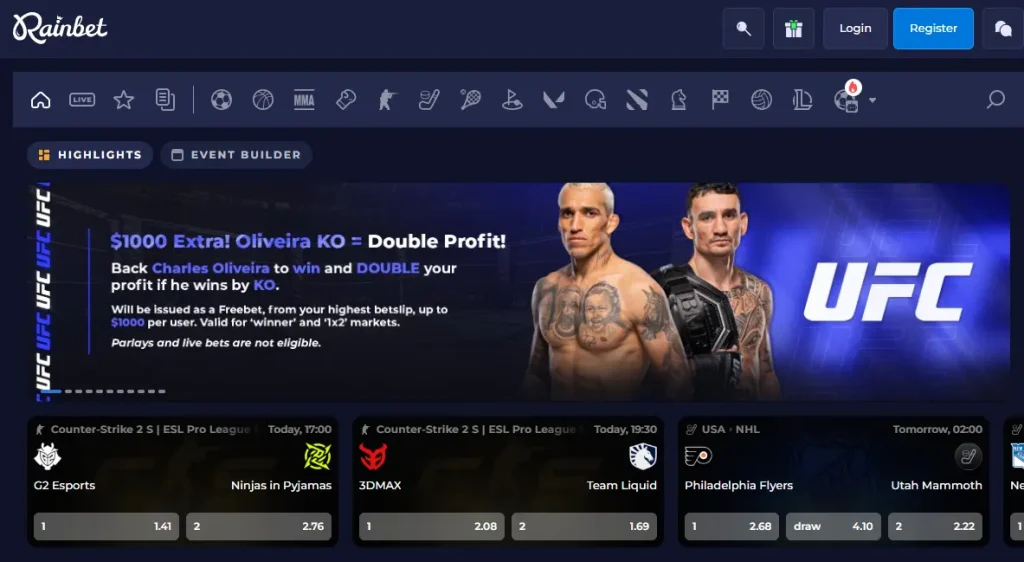


- Pre-match — the full market list, posted days ahead. Deepest liquidity and sharpest pricing.
- In-play — repriced continuously during the match. Fewer markets, wider margins, and a delay between clicking and acceptance.
- Bet builder — combine legs within one fixture. Correlation is priced in, which is why margins here run high.
- Outrights — season and tournament winners. Money is tied up for months; the margin reflects it.
- Esports — CS2, Dota 2, League of Legends and Valorant. Crypto books cover these far better than traditional ones.
Mechanics Worth Knowing
- Early payout. Some books settle a soccer bet as a winner once a team goes two goals ahead. It is a genuine concession, applied automatically, and worth having.
- Cash out. Settle a bet before the event ends at a price the book sets. That price includes an extra margin — convenient, rarely good value.
- Odds movement. The price you see is the price when the page loaded. Take-the-new-price prompts are normal on in-play; a book that silently accepts a worse price is not.
- Maximum payout. Every book caps the maximum return per bet. Check it before placing a large outright.
- Void and postponement rules. Read how the book handles abandoned matches and player withdrawals. These differ more between books than anything else.
In-play betting has a built-in delay of several seconds between placing and acceptance. If the price moves against you during it, the bet is rejected or re-offered. That is normal. What is not normal is a book that accepts the bet at the worse price without asking.
Betting With Crypto Rather Than Cash
Stake sizing is the thing people get wrong. If your balance is in BTC and you think in dollars, a 10 percent move in the asset silently changes your unit size. Betting in USDT or USDC keeps a unit a unit.
Withdrawals after settlement are the crypto sportsbook's actual selling point. A Sunday-evening NFL win can be in your wallet before midnight rather than the following Thursday. See payments for networks, fees and limits.
Free bets are the standard sportsbook promotion, and the term to check is whether the stake is returned on a winner. A 50 CAD free bet at 2.00 that returns 50 CAD is worth half what it looks like. Details on the promotions page.
Frequently Asked Questions
What is a bitcoin sportsbook?
A sports betting site that accepts deposits and pays winnings in cryptocurrency. The odds feed, market depth and in-play engine come from the same suppliers that serve conventional bookmakers. The practical differences are speed — withdrawals settle in minutes rather than days — and the absence of card issuers blocking gambling transactions.
Is crypto sports betting legal in Canada?
Canadian law regulates operators rather than bettors, and there is no offence for an individual placing a bet with an offshore book. Ontario licenses domestic operators through iGaming Ontario. The trade-off with an offshore book is that no Canadian regulator will act for you in a payment dispute, so the operator's payout record matters.
What margin do crypto sportsbooks charge?
Roughly 2 to 4 percent on major soccer, NFL and NBA markets, 4 to 7 percent on lower leagues, and 8 percent or more on same-game parlays and props. Calculate it by converting each outcome to an implied probability and summing them — anything over 100 percent is the book's margin.
How fast are sportsbook withdrawals in crypto?
Once a bet settles, a well-run book releases the withdrawal automatically and it confirms on-chain within minutes. Stablecoins on Tron or Solana are close to instant; Bitcoin usually clears inside an hour. Books that review withdrawals manually take one to three days.
Should I bet in Bitcoin or a stablecoin?
A stablecoin, unless you specifically want the price exposure. With a BTC balance your effective stake size changes as the asset moves, which quietly breaks any staking plan. USDT or USDC keeps one unit equal to one unit from the first bet to the last.
Do crypto sportsbooks limit winning accounts?
Less aggressively than regulated books, but they do. Limits usually appear as reduced maximum stakes on specific markets rather than a full account restriction. Consistent arbitrage or bonus abuse will attract attention at any book, crypto or otherwise.