
Keno online is a lottery-style draw you play against the house rather than other players. Pick numbers from a grid, the game draws a set at random, and you are paid according to how many of your picks appear in the draw.
It is the oldest game in most crypto lobbies and the one with the widest spread of house edges — anything from 3 percent to 15 percent depending on how many numbers you pick and whose paytable you are playing. That spread is the thing worth understanding before you start.
How Keno Works
A grid of 40 numbers is standard in crypto implementations, against 80 in a land-based keno lounge. Choose between one and ten numbers, set a stake, and the game draws ten.
Matches are counted and paid from a table specific to how many numbers you selected. Pick three and match three, and the payout is large. Pick ten and match four, and you may get nothing.
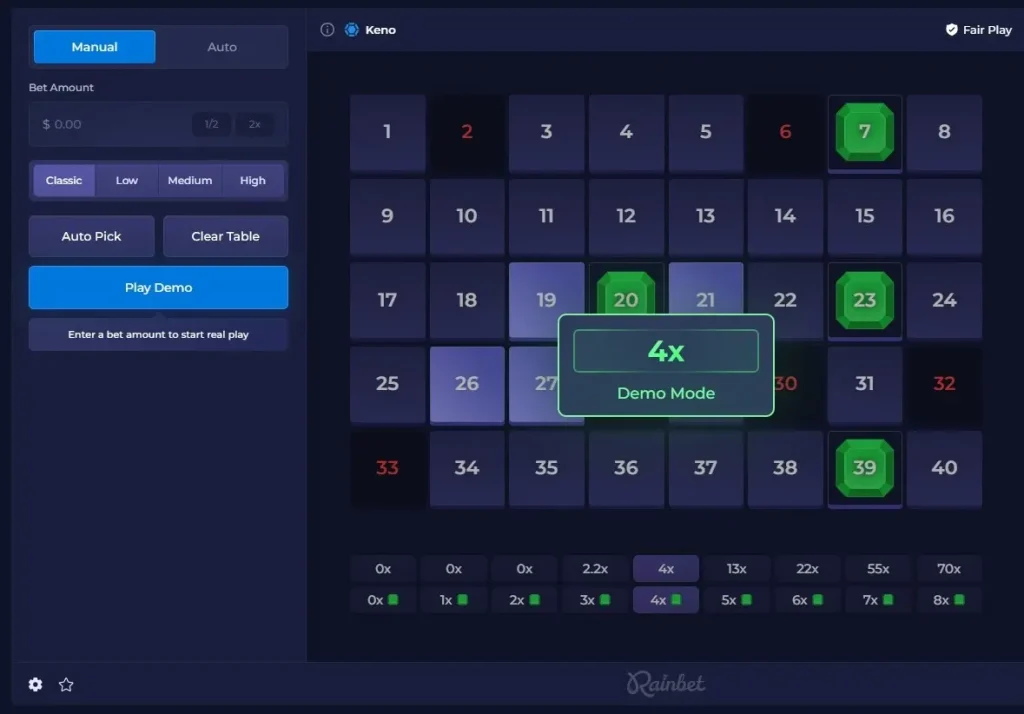
The counter-intuitive part: picking more numbers does not improve your odds. It changes the paytable, and every paytable is constructed to hold the same edge — or, on badly designed versions, a worse one at the extremes.
| Numbers picked | Chance of matching all | Typical payout for all |
|---|---|---|
| 1 | 25% | 3.8x |
| 2 | ~6% | 15x |
| 3 | ~1.3% | 40x |
| 4 | ~0.25% | 160x |
| 6 | ~0.008% | 1,500x |
| 10 | ~0.00001% | 100,000x |
Risk Levels and Paytables
Most crypto keno offers low, medium and high risk settings. These reshape the paytable without changing the return: low risk pays something for partial matches, high risk pays nothing until you hit most of your picks but pays far more when you do.
Unlike Dice or Limbo, keno's house edge is not uniform. Well-implemented versions hold around 3 to 5 percent across settings; poorly implemented ones can exceed 10 percent on specific pick counts. Check the paytable before committing to a pick count.
Strategy
There is no number selection that performs better than another. The draw is uniform and independent, so hot and cold number displays are decoration.
- Pick counts of 3 to 6 generally offer the most balanced paytables.
- Low risk produces frequent partial-match returns and slow bankroll decay.
- High risk with 8 to 10 picks is effectively a lottery ticket — long dry runs, occasional very large hits.
- Compare the paytable across pick counts before playing. The difference between the best and worst option on the same site can be several percent of edge.
Keno's house edge is typically three to five times that of Dice, Limbo or Plinko. If you are playing for value rather than for the draw-style experience, those games return substantially more per dollar wagered.
Verifying a Draw
The drawn numbers are derived from the hashed server seed, your client seed and the nonce, in the same way as every other original. The hash is published before you play; afterwards, rotating the seed pair lets you confirm the draw was fixed in advance. See provably fair.
Frequently Asked Questions
How do you play keno online?
Select between one and ten numbers from the grid, set your stake, and the game draws ten numbers at random. You are paid based on how many of your picks appear in the draw, using a paytable that changes according to how many numbers you selected.
What is the house edge on online keno?
Typically 3 to 8 percent, and occasionally higher on specific pick counts. That is considerably worse than provably fair originals such as dice or plinko, which sit near 1 percent. The exact figure depends on the operator's paytable, so it is worth comparing before you play.
Does picking more numbers improve your chances?
No. Picking more numbers makes matching all of them far less likely, and the paytable compensates with larger payouts for full and near-full matches. The expected return stays roughly constant; only the variance changes.
Are there lucky or hot numbers in keno?
No. Each draw is independent and uniformly random, so every number has the same chance on every draw. Hot and cold number displays show past results, which carry no information about future ones.
What is the best number of picks in keno?
Three to six generally gives the most balanced paytables on crypto implementations, with reasonable hit frequency and payouts. Eight to ten picks produce lottery-shaped outcomes: very long dry runs and rare large wins.
Is online keno provably fair?
On crypto sites that implement it as an original, yes. The drawn numbers come from a server seed hashed and published before you bet, combined with your client seed and a nonce, so you can verify afterwards that the draw was not altered.