
An instant withdrawal casino is one where a payout is approved automatically and broadcast to the network within minutes, rather than queued for a human to look at during business hours. For crypto sites this is achievable — the payment rail settles in seconds — but plenty of operators still choose to review manually. The difference is policy, not technology.
This page covers what deposits and withdrawals actually look like, which networks to use, what the limits and fees are, and how to test an operator's payout speed before you trust it with a real balance.
Depositing
Select the asset, select the network, and the cashier shows an address and a QR code. Send from your wallet or exchange. The balance credits after the required number of confirmations — usually one to three.
The critical step is the network selector. USDT exists on Ethereum, Tron, Solana, BNB Chain and others, and they are not interchangeable. Sending Tron-USDT to an Ethereum address loses the funds permanently.
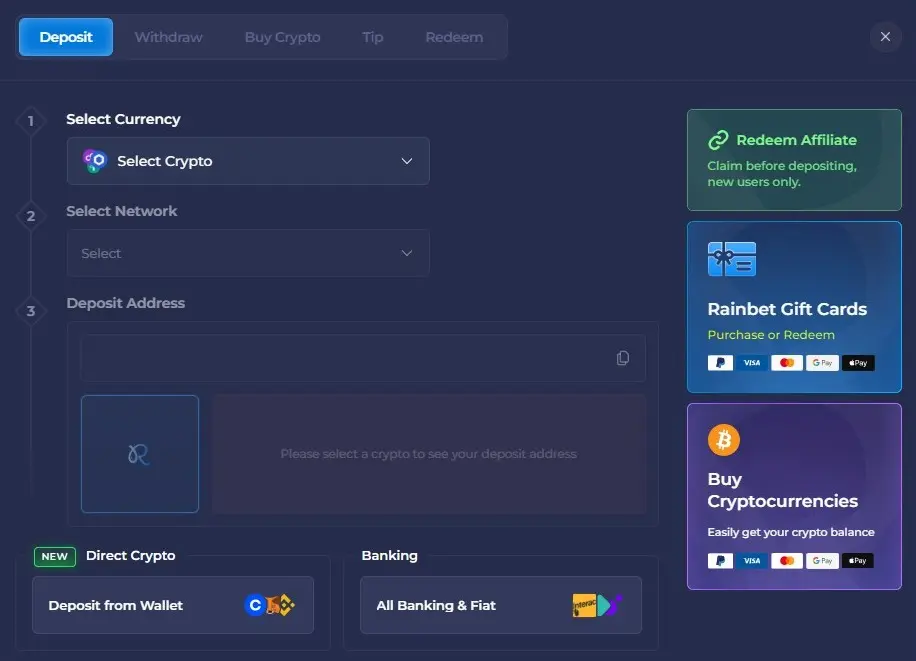
| Step | What to check |
|---|---|
| Asset | Must match exactly what your wallet is sending |
| Network | The most common and most costly mistake. Match it precisely |
| Minimum | Typically 10 to 20 CAD equivalent |
| Confirmations | One to three blocks; longer for large amounts |
| Memo / tag | Required for XRP and a few others. Omitting it delays or loses the deposit |
| Address reuse | Most sites issue a permanent address per asset; some rotate |
Deposits sent on the wrong network are generally unrecoverable. Some operators will attempt a manual recovery for a fee, many will not. Send a small test transaction the first time you use a new asset or network.
Buying Crypto Inside the Cashier
On-ramps such as MoonPay let you buy directly with a card, Apple Pay or Google Pay without leaving the site. It is the fastest route from nothing to a funded balance.
It costs 3 to 5 percent against buying on an exchange and transferring in. Worth paying once to get started; not worth paying every week.
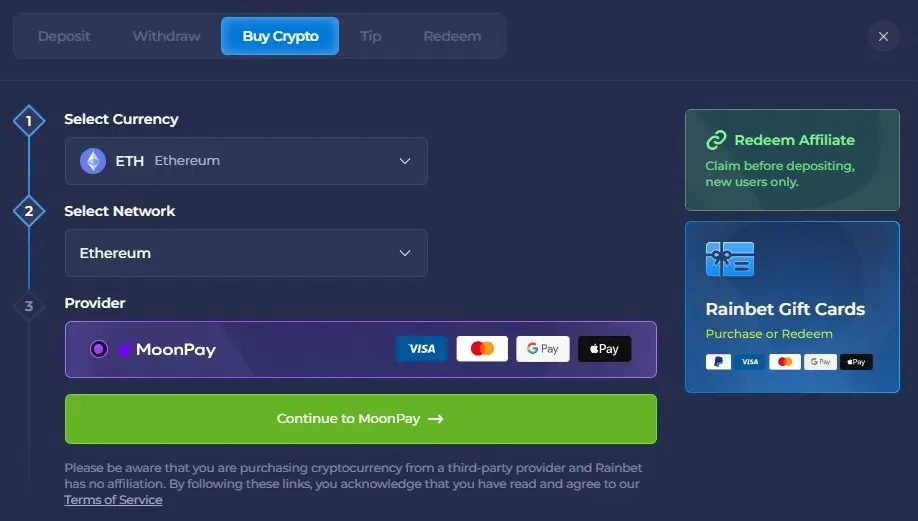
Note that this route runs identity verification through the on-ramp provider, so the "no KYC at signup" characteristic of many crypto casinos does not apply to card purchases.
Withdrawing
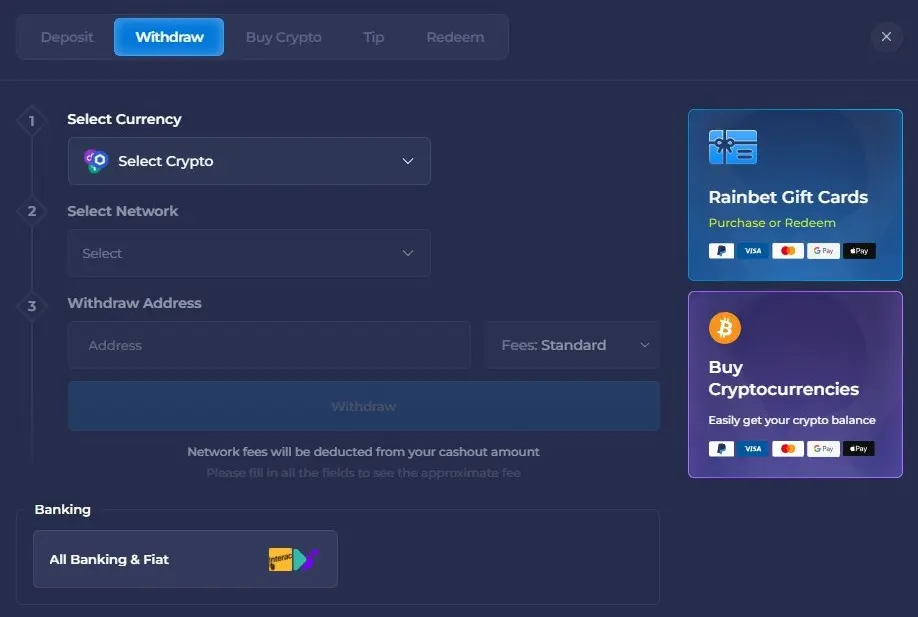
Enter your wallet address, choose the network, confirm the amount. On an automated site the transaction is broadcast within minutes and confirms according to network speed. On a manual site it enters a review queue.
Withdrawal address whitelisting, where available, is worth enabling. It means a compromised account cannot send funds anywhere except an address you pre-approved.
| Network | Typical fee | Typical confirmation |
|---|---|---|
| Solana | Fractions of a cent | Seconds |
| Tron (TRC-20) | ~1 CAD | Under a minute |
| Litecoin | Cents | 2–5 minutes |
| Bitcoin | Variable with congestion | 10–60 minutes |
| Ethereum (ERC-20) | Several CAD, sometimes much more | 1–5 minutes |
| Polygon / BNB Chain | Cents | Under a minute |
Typical limits on a mid-sized operator: around 5,000 per day, 50,000 per week, 100,000 per month, with VIP tiers raising all three. Minimum withdrawals are usually set above the network fee so the transaction is not consumed by cost.
Testing Payout Speed Before You Commit
This is the single most useful thing you can do with a new site, and it takes fifteen minutes.
- Deposit a small amount — the minimum is fine.
- Wager enough to satisfy any anti-money-laundering play-through requirement, which is usually one times the deposit.
- Request a withdrawal of most of the balance.
- Time it from request to on-chain broadcast.
- Note whether verification was triggered and how quickly it was processed.
A site that pays a small withdrawal in minutes will usually pay a large one in minutes. A site that takes two days on a small one will not improve when the amount grows.
Verification
Many crypto casinos defer identity checks until a trigger fires: a cumulative withdrawal threshold, an unusually large single payout, a bonus dispute, or a routine anti-money-laundering review. "No KYC" almost always means "no KYC at signup" rather than never.
The practical advice is to have a government ID and a recent proof of address ready before you need them. Verification requested mid-withdrawal is the most common cause of a payout that should have taken minutes taking days. More on the registration page.
Frequently Asked Questions
How fast are crypto casino withdrawals?
On a site with automated payouts, the transaction is usually broadcast within a few minutes of the request and then confirms at network speed — seconds on Solana, under a minute on Tron, up to an hour on Bitcoin. Operators that review withdrawals manually typically take one to three days.
What is the cheapest network to use?
Solana and Tron are close to free. Litecoin and Polygon cost cents. Bitcoin varies with congestion. Ethereum mainnet is the expensive option and only makes sense for amounts large enough that a few dollars of gas is irrelevant.
What happens if I send crypto on the wrong network?
The funds are usually unrecoverable. Some operators attempt a manual recovery for a fee, but many cannot. The network selector on the deposit screen must match the network your wallet is sending from — always send a small test first when using a new combination.
What is the minimum deposit at a crypto casino?
Usually the equivalent of 10 to 20 CAD, though some sites go lower. The practical floor is the network fee: a five-dollar deposit over Ethereum makes no sense when the gas costs more than the deposit itself.
Do I need to verify my identity to withdraw?
Often not for small amounts, but most operators verify at some threshold or when their anti-money-laundering policy requires it. Having ID and proof of address ready in advance is the difference between a payout taking minutes and taking days.
Should I hold my balance in Bitcoin or a stablecoin?
A stablecoin such as USDT or USDC if you do not want the balance to move in value while you play. Bitcoin if you already hold it and are comfortable with the exposure. For a session lasting days, the price move can easily exceed anything you win or lose at the tables.