
The Limbo game is Crash with the waiting removed. You pick a target multiplier, place a stake, and the round resolves instantly: if the generated multiplier is at or above your target you win, otherwise you lose. One click, one result, no cash-out decision.
That simplicity makes it the most transparent game in any originals lobby. The payout is derived straight from the probability you chose, and the house edge is visible in the gap between the two.
How Limbo Works
Set a target — 2.00x, 10x, 1000x, anything the interface allows. The site generates a random multiplier from the current seed pair and nonce. At or above your target, you are paid the target; below it, the stake is lost.
Because there is no cash-out, there is no decision to get wrong. The only choice is where to set the target, and that choice is purely a variance choice.
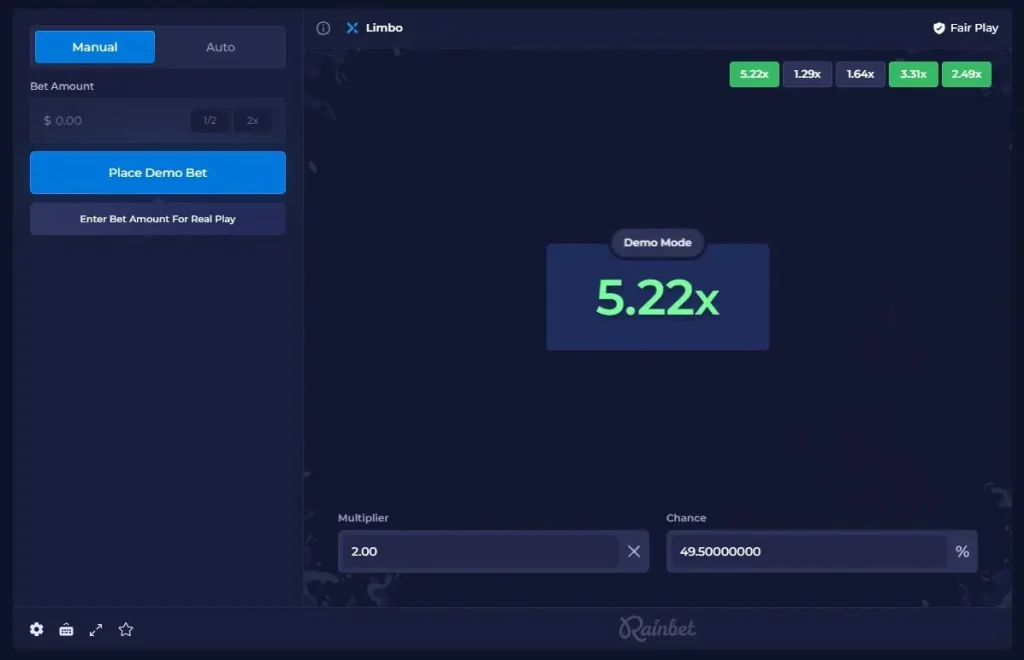
The win probability for a target of m is approximately 99 / m percent. A 2.00x target wins 49.5 percent of the time. A 10x target wins 9.9 percent. A 100x target wins 0.99 percent. The 99 rather than 100 is the house edge.
| Target multiplier | Win probability | Expected result per 100 bets |
|---|---|---|
| 1.01x | 98.0% | 98 wins, 2 losses |
| 2.00x | 49.5% | ~50 wins |
| 5.00x | 19.8% | ~20 wins |
| 10.00x | 9.9% | ~10 wins |
| 50.00x | 1.98% | ~2 wins |
| 100.00x | 0.99% | ~1 win |
| 1000.00x | 0.099% | ~1 win in 1,000 |
Every target has the same 1 percent house edge. A 1.01x target and a 1000x target return the same amount per dollar over the long run. The difference is entirely in how that return arrives.
What the Numbers Mean in a Session
A 100x target wins about once in a hundred bets — but "about once in a hundred" does not mean once per hundred. Runs of three hundred losing bets at that target are unremarkable; so are two hits inside twenty bets. The distribution is memoryless, and nothing about the previous result affects the next.
This is where Limbo catches people. The visible history of recent multipliers invites pattern-reading, and there is no pattern to read. A screen full of low results does not make a high one due.
Limbo resolves in under a second, which makes it the easiest game on the site to over-play. Four hundred rounds an hour at 5 CAD is 2,000 CAD of turnover and about 20 CAD of expected loss — before variance. Set a session limit before you start.
Strategy
There is no target that beats the edge, and no progression that changes it. What target selection does control is bankroll survival.
- Low targets (1.1x–2x) produce frequent small wins and shallow drawdowns. The slowest way to lose.
- Medium targets (5x–20x) are the usual compromise: losing runs of twenty to fifty are normal.
- High targets (100x+) will show hundreds of consecutive losses. Only viable with stakes small enough that a four-hundred-bet dry run is survivable.
- Martingale is particularly dangerous here because the fast round time lets a doubling sequence reach the table maximum within a couple of minutes.
Verifying a Round
The multiplier is derived from the hashed server seed, your client seed and the nonce, all published before the bet. Rotate the seed pair afterwards, confirm the revealed server seed hashes to the value you were shown, and recompute the result. Full procedure on the provably fair page.
Limbo Compared
| Game | Decision during round | House edge |
|---|---|---|
| Limbo | None — target set up front | ~1% |
| Crash-style games | Cash out while multiplier rises | ~1% |
| Dice | None — threshold set up front | ~1% |
| Plinko | None — risk set up front | ~1% |
| Mines | Reveal or stop, each tile | ~1% |
Dice is Limbo's closest relative — same edge, same absence of in-round decisions, different interface. If you prefer choosing a win probability directly rather than a multiplier, play Dice.
Frequently Asked Questions
How does the Limbo game work?
You choose a target multiplier and place a bet. The site generates a random multiplier; if it lands at or above your target you are paid that multiplier, and if it lands below you lose the stake. The round resolves instantly with no cash-out step.
What is the RTP of Limbo?
Around 99 percent, a 1 percent house edge. The win probability for any target is roughly 99 divided by the target — so a 2x target wins 49.5 percent of the time rather than the 50 percent fair odds would give.
What is the maximum multiplier in Limbo?
Most implementations allow targets up to 1,000,000x, though the practical ceiling is the site's maximum payout per bet. A 1,000,000x target wins roughly once in a million bets, which is not a strategy so much as a lottery ticket.
Is there a Limbo strategy that works?
No. Every target carries the same expected return, and each round is independent of the last, so no progression or pattern changes the outcome. Target choice controls variance only: low targets mean frequent small wins, high targets mean long dry runs.
Why do I keep losing at high multipliers?
Because that is what the probability says should happen. A 100x target wins slightly under 1 percent of the time, so runs of two or three hundred losses are entirely normal. The game is not colder than usual — the sample is just small.
Is Limbo the same as Crash?
Mathematically yes, presentationally no. Crash shows a multiplier rising in real time and asks you to cash out; Limbo asks for the target up front and resolves instantly. Same distribution, same edge, no in-round decision.