
The Wheel casino game is a segmented wheel that spins to a random stop. Each segment carries a multiplier; where the pointer lands decides the payout. You choose the number of segments and the risk level before spinning, which together determine how the multipliers are distributed.
There is no decision during the round. Like Plinko, everything is settled the moment you spin.
How Wheel Works
Set a stake, choose how many segments the wheel should have — typically 10, 20, 30, 40 or 50 — and pick low, medium or high risk. Spin. The pointer stops on a segment and you are paid that segment's multiplier.
Every segment is equally likely. A 20-segment wheel gives each segment a 5 percent chance; a 50-segment wheel gives each 2 percent.
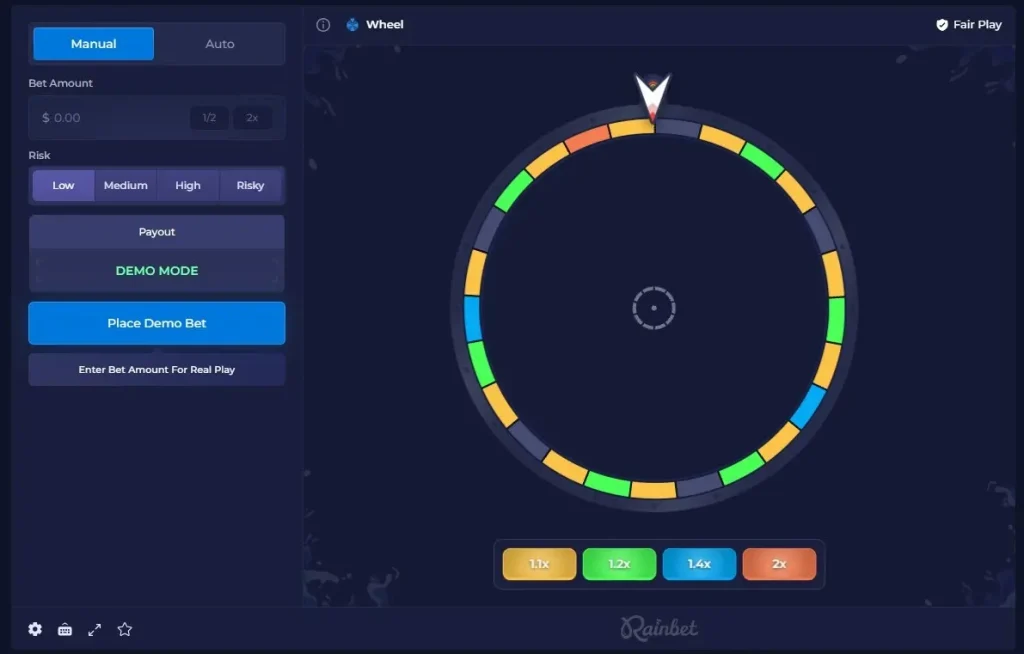
Risk level controls how many segments pay nothing and how large the paying segments are. On low risk most segments pay something close to 1.2x to 1.5x and few pay zero. On high risk the majority pay zero and one segment may pay 50x.
| Risk | Zero-payout segments | Top multiplier | Session feel |
|---|---|---|---|
| Low | Few | ~1.5x | Slow decay, small swings |
| Medium | Roughly half | ~3–10x | Balanced |
| High | Most | ~30–50x | Long dry runs, rare large hits |
Segment count and risk reshape the distribution without altering the roughly 1 to 3 percent house edge. A 50-segment high-risk wheel and a 10-segment low-risk wheel return the same amount per dollar over the long run.
Strategy
The wheel has no in-round decisions, so the only levers are configuration and stake size.
- Low risk if you want a session to last. It is the shallowest loss curve on offer.
- High risk only with stakes small enough that twenty or thirty consecutive zero segments are survivable.
- Ignore the history strip. Each spin is independent; a run of zeros does not make a payout due.
- Avoid auto-spin at speed. The round takes seconds, and turnover accumulates faster than the balance suggests.
Some wheel implementations run a higher house edge than other originals — up to 3 percent against the 1 percent typical of Dice or Limbo. Check the stated RTP in the game's info panel rather than assuming it matches the rest of the lobby.
Verifying a Spin
The stopping segment is derived from the hashed server seed, your client seed and the nonce. The hash is published before the spin; afterwards you can rotate seeds, verify the hash and recompute the result. See provably fair.
Frequently Asked Questions
How does the Wheel casino game work?
You choose a stake, a number of segments and a risk level, then spin. The wheel stops on one segment, every segment being equally likely, and you are paid that segment's multiplier. There are no decisions to make once the spin begins.
What is the RTP of the Wheel game?
Usually between 97 and 99 percent depending on the operator, so a house edge of roughly 1 to 3 percent. It is worth checking the info panel, because wheel implementations vary more than dice or plinko do.
Does the risk level change the return?
No. Risk changes how many segments pay nothing and how large the paying segments are, which alters variance. The expected return per dollar wagered stays the same at every risk level and segment count.
Is there a strategy for the Wheel game?
None that changes the expectation. Each spin is independent and the edge is fixed, so the only meaningful choices are risk level, which controls volatility, and stake size, which controls how long the bankroll survives.
Do previous spins affect the next one?
No. Every spin is generated independently from the seed pair and nonce. A long run of zero-payout segments carries no information about what comes next, and the results strip is purely a record.
Is the Wheel game provably fair?
On sites that implement it as an original, yes. The winning segment is derived from a server seed hashed and published before the spin, which you can verify afterwards by rotating seeds and recomputing the result.